This page is in English.
The new standard: the European biomethane plant
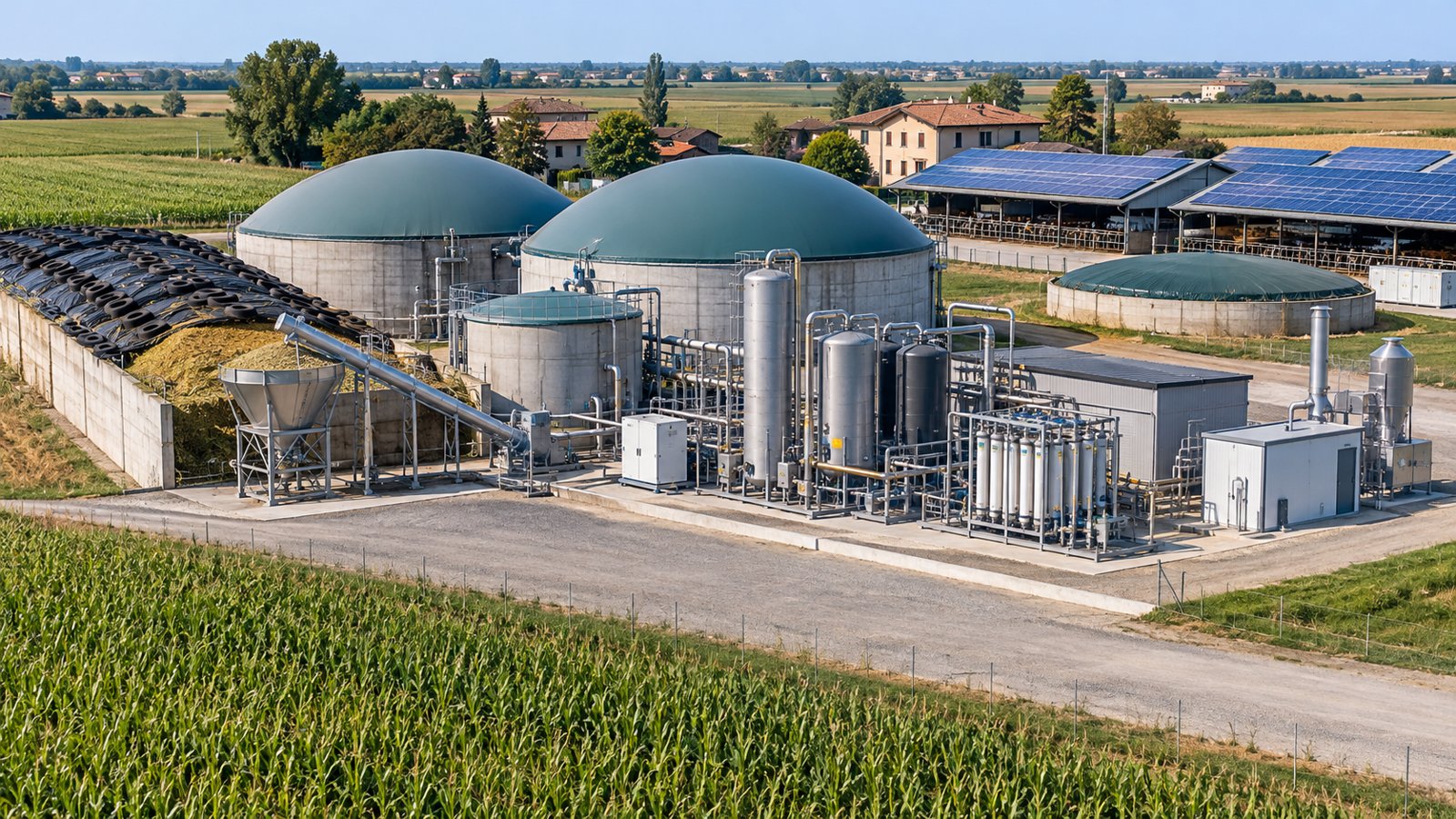
A biomethane plant in the Po Valley. The maize silage clamp is at left under black sheeting and tyres, two digesters sit under green double-membrane gas domes at centre, and the gas-cleaning and upgrading train runs along the front: desulphurisation vessels, the membrane upgrading skid with its vertical modules, and a thermal oxidiser stack at right. A covered digestate tank stands to the right, with solar panels on the dairy sheds behind.
This is the second article in the series on the European model. In it I discuss the standard biomethane plant, focusing mainly on Italian plants.
What it looks like
The biomethane plant is the same digestion core as the electricity plant, grown up and re-fitted. The visible differences are three.
First, the digestion is larger and staged. Where the electricity plant had a single digester, the standard biomethane build has two or more continuously stirred tank reactors. Behind the digesters the digestate storage is covered, with a gas-tight membrane rather.
Second, the feed has broadened. Maize silage, grown mostly as a single full-season crop, is still the mainstay, with livestock effluents and agro-industrial by-products added alongside it. The incentive does not pay more for one agricultural feed than another: an agricultural plant earns broadly the same reference rate per unit, around 31 to 32 euros per GJ before the auction discount, whether it runs on manure, by-products or maize.
Third, and this is the defining change, a gas-cleaning and upgrading train is added to turn the raw biogas into pipeline-grade methane. The biogas is first desulphurised, in a staged train that takes hydrogen sulphide down to about one part per million without letting air into the gas: biological removal with dosed pure oxygen for the bulk, then an iron oxide bed, then activated carbon. The gas is then dried and passed through membrane modules, raising it to pipeline-grade biomethane. A compressor lifts it to the pressure of the gas network, most often the local distribution network at around ten bar, and injects it. The off-gas is sent to a thermal oxidiser rather than vented, a flare stands by for off-spec gas, and the carbon dioxide stream is sometimes recovered and liquefied as a saleable product.
The gas engine is not always removed in the move to biomethane. The digesters still have to be held at around 35 degrees C, so the plant still needs process heat, and a scaled-back combined heat and power engine is often kept to supply that heat, and some on-site power, while the bulk of the biogas now goes to the upgrading train rather than to the engine. The plant still carries a continuous electrical load from the compressor and the upgrading unit, so most of these plants add solar panels.
The plant has one main product; biomethane to the grid, and several byproducts; digestate and sludge which are returned to the fields, and carbon dioxide which is vented or recoverd.
How many there are
The biomethane segment is smaller and newer than the electricity fleet but growing fast. Europe ended 2024 with 1,620 biomethane-producing facilities and passed 1,678 by the first quarter of 2025, according to the European Biogas Association and Gas Infrastructure Europe European Biomethane Map. At least 86 percent are connected to the gas grid, and of the plants mapped, close to half inject into the local distribution network rather than the high-pressure transport system. France has overtaken Germany to lead on plant numbers. Italy has grown from fewer than 10 biomethane plants in 2018 to well over a hundred operational by 2025, with close to 400 more certified under the 2022 scheme and building toward operation, a pipeline of about 50 PJ a year. Around 28 billion euros of private investment has been committed to European biomethane ahead of 2030, expected to add some 950 further plants.
The size of the unit
The biomethane plant is deliberately larger than the electricity plant, because upgrading pays better at scale, yet it is still farm-scale rather than industrial. The average European biomethane plant produces about 0.15 PJ a year, which the EBA describes as only about four times the size of a traditional electricity plant.
Sources
European Biogas Association, 15th Statistical Report (2024 to 2025 data, published December 2025), for the 1,620 biomethane facilities at end 2024, the average biomethane plant size of about 0.15 PJ a year, or 150 TJ (the EBA's 483 cubic metres an hour, at roughly 38 MJ per cubic metre and about 8,000 operating hours a year), and the roughly 28 billion euros of committed private investment with some 950 plants expected. EBA and Gas Infrastructure Europe, European Biomethane Map 2025, for 1,678 biomethane facilities as of Q1 2025, at least 86 percent grid-connected with close to half on the distribution network, and France overtaking Germany. Italy's biomethane plant count from the MASE 2025 report, PwC and biorig analyses (fewer than 10 plants in 2018 to well over a hundred operational by 2025) and Il Sole 24 Ore (close to 400 plants certified under the 2022 scheme, about 50 PJ a year, converting at roughly 38 MJ per cubic metre). Italian Ministerial Decree of 15 September 2022 for the biomethane incentive: a reference tariff of around 31 to 32 euros per GJ for agricultural plants (about 62 for waste-fed plants), the same for transport and other uses and set by plant type and size rather than by the specific feedstock, awarded through competitive auctions with a capital grant up to 40 percent (GSE application rules, Bird & Bird and CIB analyses, BTS Biogas tariff tables). On the solid, or dry, horizontal plug-flow digestion stage used in place of a wet hydrolysis tank: the project note drawing on Eisenmann two-stage plant documentation (Leona case study and the Semi-Dry horizontal agitated digester for dry matter above 30 percent). Author's standard biomethane plant concept note, built on the Emilia-Romagna survey, the Italian injection rules, membrane-vendor data, one operating plant's control system and the ARPAE authorisation of the CO-VER San Giovanni plant, for the multi-digester configuration, the retained process-heat engine, the staged desulphurisation train and the membrane upgrading section.
Comments
No comments yet.