This page is in English.
The old standard: the European biogas-to-electricity plant
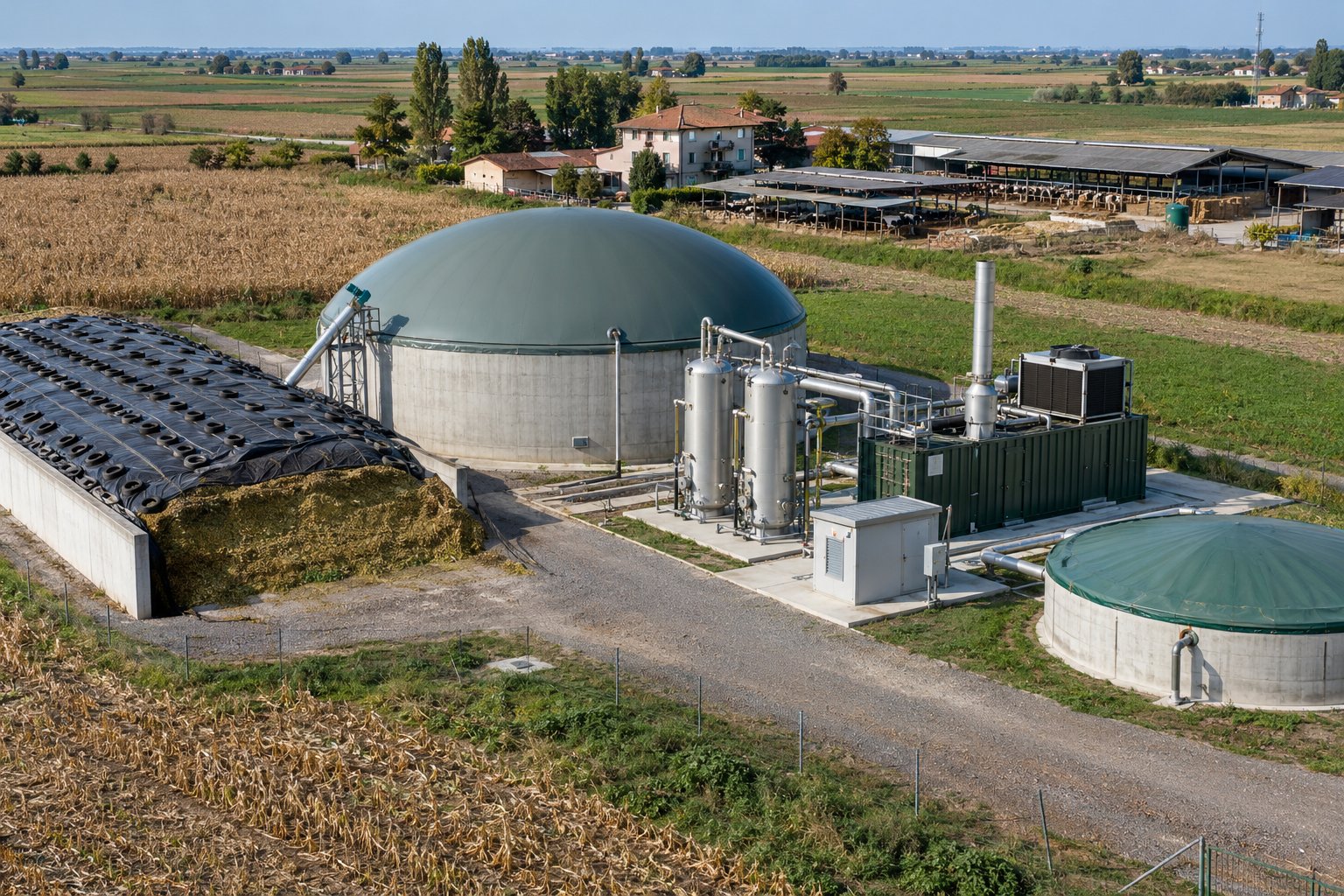
A farm-scale biogas-to-electricity plant in the Po Valley. The maize silage clamp is at left, the main digester under its green double-membrane gas dome at centre, the twin steel desulphurisation vessels and the combined heat and power engine module (the green container with a roof-mounted radiator and exhaust stack) at right, and a second covered digester tank in the foreground. A dairy farm with cattle sheds stands behind.
The European model biogas plant is often discussed in biogas circles, but what exactly does that mean? In this series of articles I will explore the concept, starting with the plant that built the fleet and still underlies today's biomethane plants: the farm-scale biogas plant built to make electricity.
What it looks like
The standard biogas-to-electricity plant is an agricultural installation of roughly half a megawatt to one megawatt of electrical capacity, built on or beside a working farm. At its core is a single continuously stirred tank reactor, a mesophilic digester running at around 35 degrees C, fed a mixture of livestock slurry and manure with crop material, most often first-harvest maize silage. Around that core sit a feed hopper and a silage clamp, the maize held under black plastic weighted with tyres, and one or two digestate storage tanks. The raw biogas, roughly 55 to 60 percent methane with the balance mostly carbon dioxide, is cleaned of hydrogen sulphide, historically by dosing a little air into the digester and often by passing the gas through a steel vessel of iron oxide, and then burned on site in a combined heat and power engine, a module about the size of a shipping container with a short exhaust stack and a radiator, which sends electricity to the grid.
It was a creature of its feed-in tariff. The all-inclusive tariff that drove the build-out paid 280 euros per MWh of electricity (0.28 euros per kilowatt hour), about 78 euros per GJ, for fifteen years, to any plant under one megawatt, and it paid for the electricity whatever was burned to make it. From 2013 the rate was cut to roughly 160 to 260 euros per MWh (about 44 to 72 euros per GJ) over twenty years, with the top band kept for small plants on by-products. Because the tariff paid best in a band at or just below one megawatt, the plant was sized to the tariff rather than to the farm and fed on a dedicated energy crop that gave a high and predictable yield. That is why the plants of the 2008 to 2013 boom look so alike: one digester, one silage clamp, one engine.
How many there are
The legacy fleet is large. The most recent full plant-by-plant European count, in the European Biogas Association Statistical Report covering 2018, put it at 18,202 biogas plants across Europe. Germany alone had 11,084, Italy 1,655, France 837, the United Kingdom 715 and Switzerland 634. Agricultural feedstocks, meaning livestock manure, farm and plant residues and energy crops, drove roughly 65 to 70 percent of that market, and almost all of these plants were built to make electricity and heat rather than to inject gas.
The size of the typical unit
The typical plant is sub-megawatt, but the two figures usually quoted measure different things and have to be kept apart. The first is a fleet-wide average: across all of Europe the mean plant was about 0.61 megawatts electrical in 2018, being an installed electric capacity of 11,082 megawatts spread over 18,202 plants. That average is held down by Germany, which accounted for more than eleven thousand of those plants, many of them small manure and waste digesters, so it describes the European fleet as a whole rather than any one national build.
The second figure is a distribution, and it is the one that fits the Italian fleet this series is built on. Italy has more than 1,500 anaerobic digestion plants for about 1,400 megawatts electrical, a mean close to 0.9 megawatts, and more than 60 percent of them fall in the 200 kilowatt to 1 megawatt band. So the standard Italian plant is a little under one megawatt: larger than the pan-European average, because Italy has fewer of the very small German-style units, but still firmly in the agricultural, sub-megawatt range rather than the industrial one.
What comes next
This fleet is now at a turning point. The feed-in tariffs that built it run for a fixed period, commonly fifteen years, and the plants of the 2008 to 2013 boom are now reaching the end of theirs. Expiry does not force a single path. With the capital cost amortized, an on-farm plant running on its own manure and by-products can simply keep producing electricity and sell it at the wholesale market price, lately very roughly 100 to 120 euros per MWh (about 28 to 33 euros per GJ). The Italian tax regime helps here: output up to 2.4 GWh a year counts as agricultural income and is taxed on a cadastral basis that is close to nothing, and the excess is taxed only on a 25 percent lump-sum of its market value, so the margin left after low operating costs can be real. Small plants up to 300 kilowatts fed on by-products can instead take continued support of about 233 euros per MWh (around 65 euros per GJ) for twenty years under the FER 2 scheme, and a February 2026 law decree offers a short extension at a reduced rate. Converting to upgrading the gas and injecting biomethane is the route the current incentives most strongly reward, but it is extra upside rather than a rescue.
Sources
European Biogas Association, Statistical Report (edition covering 2018), for the European plant count of 18,202 and the national figures (Germany 11,084, Italy 1,655, France 837, United Kingdom 715, Switzerland 634), the 65 to 70 percent agricultural feedstock share, and the 0.61 MWe fleet average derived from 11,082 MW of installed electric capacity across 18,202 plants. University of Verona study of Italian anaerobic digestion plants, for more than 1,500 units totalling about 1,400 megawatts electrical (a mean near 0.9 MWe) and more than 60 percent in the 200 kilowatt to 1 megawatt band. GSE for the Italian feed-in tariff structure and its fifteen-year term. Author's survey of the Emilia-Romagna, Lombardia and Piemonte fleets for the plant anatomy and the predominance of sub-megawatt agricultural digesters.
Comments
No comments yet.