This page is in English.
The FuelEU Carbon Price Has Halved. The Real Question Is Where It Settles.
Damien Spagnuolo
The third in a series on shipping's fuel transition. The first looked at what China's export tax change did to green methanol. The second argued that without the IMO, FuelEU is a regional rule with a porous edge. This one is about the price that edge produces, and where it is heading.
FuelEU Maritime does not force any single ship to burn a cleaner fuel. It sets a limit on the average greenhouse gas intensity of the energy a ship uses, and then lets ships trade their way to compliance. A ship that does better than the limit earns a surplus. A ship that does worse can buy that surplus through a pool. The price of that surplus is the price of compliance. It is the cleanest signal the regulation produces of what the whole apparatus is actually worth.
That price has been repriced hard.
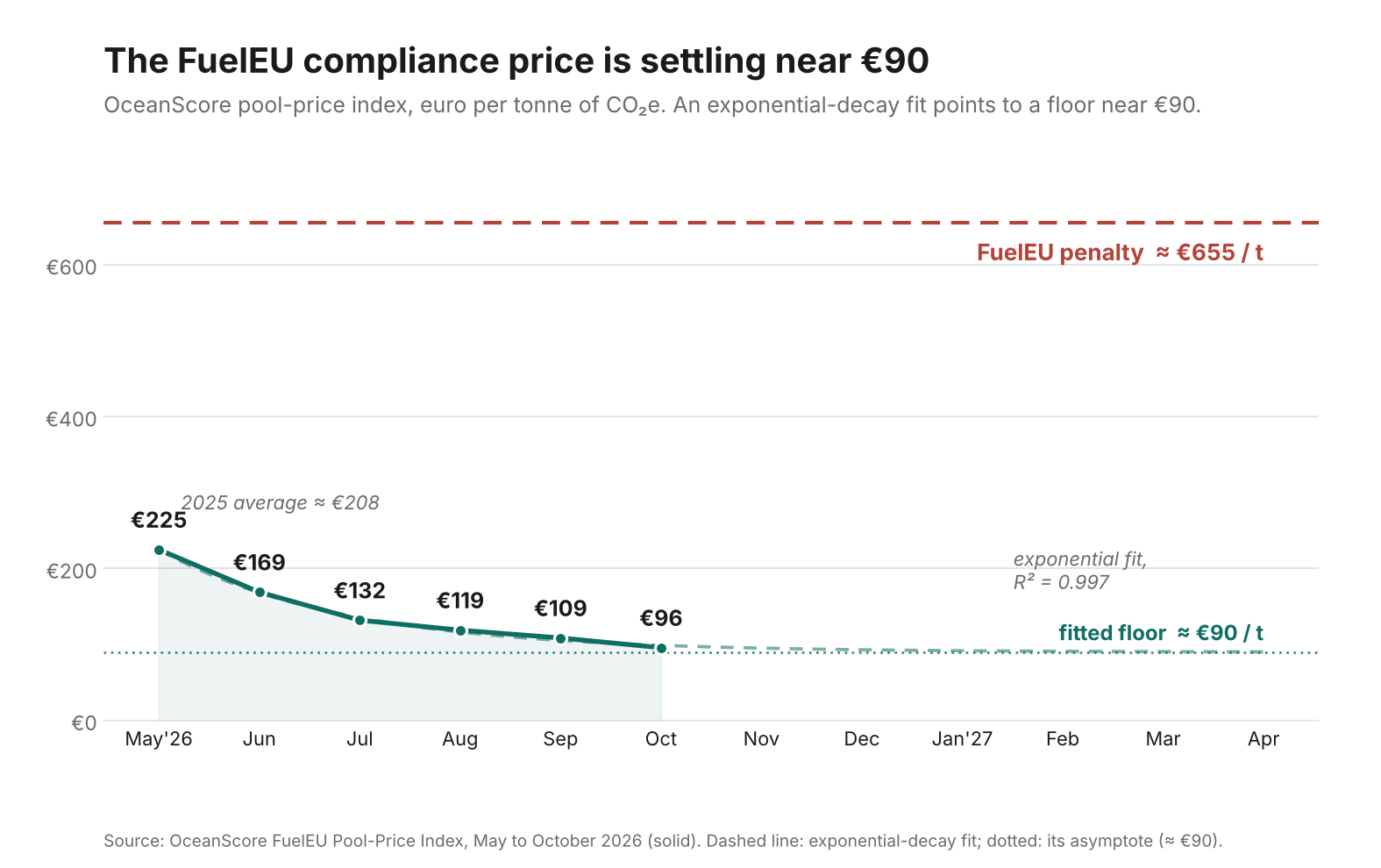
OceanScore's pool-price index stood at about €225 per tonne of CO2e in May 2026. By 20 October it was €95.80, its fifth consecutive monthly fall, down about 57% in five months. The penalty for missing the target, the number the whole market is priced against, works out at about €655 per tonne. Compliance is clearing at roughly a seventh of it.
This is a severe revaluation, not a failed market. The pool still trades, and €96 is a real price. What has changed is that the market has looked at what compliance under these targets actually costs and marked it down by more than half. The questions that matter are where the price settles, and whether anyone in Brussels treats the answer as a problem.
We have seen the end of this road
There is a market that did collapse, and it is worth holding up beside this one.
In 2023 the voluntary carbon market went to the floor. Nature-based credits assessed by Platts fell about 96% over the year, from €4.65 to €0.20 per tonne. CORSIA-eligible credits fell 78%. Credits that had traded in the double digits a year earlier changed hands for cents. That is a collapse: the asset became worthless and the market for it seized up.
The cause was not a mystery. Registries had issued roughly 5 billion tonnes of credits and buyers had retired far fewer, leaving about 3.5 billion tonnes unused. A January 2023 investigation by the Guardian, Die Zeit and SourceMaterial reported that the great majority of the leading rainforest method's credits stood for reductions that never happened. Oversupply met a loss of confidence, and the price found the floor. Economists who later wrote an autopsy of the market called it a market for lemons, in which cheap and doubtful credits crowd out the good ones.
The FuelEU pool is not there. But it is on the same road, and for the same reason. The point of the comparison is not that the two prices are the same today. It is that oversupply in a credit market has a known destination, and the pool is travelling towards it.
The same mechanism, a different market
FuelEU pooling is not the voluntary carbon market. One is a legal obligation, the other a reputational choice. But they are the same kind of machine.
Both create a tradable credit for doing better than a baseline. Both depend on that credit being scarce enough to carry a meaningful price. And both let a buyer meet its obligation by writing a cheque to someone who over-complied, rather than by changing its own fuel. In the FuelEU pool, a company whose ships burn conventional fuel can join a pool with ships that beat the target, pay for their surplus, and be certified compliant without altering a single bunker stem. In the first compliance year, pooling was how the market cleared: more than 90% of ships used it, 92% by the marine insurer Skuld's count, and only about 2% resorted to borrowing. It is compliance by allocation, not by fuel.
The autopsy of the voluntary market found something that should worry anyone relying on the pool. Firms that stopped using offsets after the 2023 shock went on to cut their own emissions by about 20% more than firms that kept buying them. The offsets had been a substitute for real abatement. While they were cheap and available, buying them was easier than changing anything. A cheap compliance credit is not a sign of an efficient market. It is a sign that the mechanism is not driving the change it was built to drive.
Where does it settle
The pool price is not falling at random. It is being pulled down towards the cost of the cheapest way to comply, and that is a real number.
The target for 2025 to 2029 is a 2% cut in greenhouse gas intensity. Fossil LNG already beats it on every engine, so every LNG ship is a surplus generator before it burns a drop of anything renewable. Waste-based biodiesel, a drop-in fuel that needs no new ship, supplied about 68% of the renewable fuel used for compliance in the first year. Adjusted for the ETS, switching a ship from conventional fuel to waste-based biodiesel costs a little over €100 per tonne of CO2e abated. That is the cost of the marginal compliance tonne, and the pool has settled just below it.
That floor is softer than it looks, because the biodiesel holding it down rests partly on feedstock that may not be what it claims. In a separate briefing I set out how oil drawn from palm oil mill effluent, and even crude palm oil skimmed from a mill's de-oiling pit, is certified as an advanced waste under ISCC rules and shipped into the European biodiesel and aviation pools. Reported European consumption of this one "waste" already runs to about 2 million tonnes a year, against a plausible global supply of 1 to 1.5 million. It is the same disease that felled the voluntary carbon market, in a different organ: a compliance tonne that stands for less real abatement than it claims, waved through by the rules meant to police it. The cheaper and more plentiful that feedstock, the lower the floor it sets under the pool.
So the floor, for now, is roughly the cost of biodiesel abatement, somewhere not far from where the price already sits. It could go lower. Surplus can be banked, and banked surplus does not expire, so every cheap tonne generated in an oversupplied market today is carried forward to soften demand tomorrow. A market that is long on paper and getting longer does not find a higher price on its own. The one thing that would lift it is scarcity, and scarcity only comes when the targets tighten enough to outrun cheap biodiesel and fossil-LNG surplus. On the current schedule that is years away.
The decline so far fits an exponential decay almost exactly, an R-squared of 0.997, and that curve has an asymptote: the level the price is settling towards. It comes out at about €90 a tonne, give or take €5. A five-month fit is a trajectory, not a promise, and a real market will wobble around that line rather than trace it. But the floor it points to is set by something real, the cost of the cheapest compliance tonne, so the number is worth taking seriously. Through 2029, with the target held at a 2% cut, expect the pool to sit near €90, drifting lower in the quiet months as banked surplus builds. The first real test is 2030, when the cut steps from 2% to 6%. That should firm the price, because fossil LNG's free surplus shrinks and biodiesel is already near the limit of what genuine waste feedstock can honestly supply. But firm is not the same as fixed. Banked surplus from the cheap years floods back in, and the most likely path for 2030 to 2034 is a partial recovery, back towards €150 to €200, not a return to the penalty. A compliance price that spends the decade between €90 and €200 is a price that never says "build a green methanol plant."
What FuelEU will do about it
Probably nothing, and that is the part worth sitting with.
The low price is not a malfunction the Commission will rush to fix. It is the price finding the level the design points it to. The early targets were set deliberately loose, to ease the industry in. Pooling and banking were written into the regulation on purpose. The review machinery is slow and the next meaningful tightening does not arrive until 2030. Nothing obliges Brussels to act on a compliance price that is doing exactly what a 2% target in an oversupplied market produces.
That leaves a regulation whose own price signal, for the rest of this decade, says the cheapest thing to do is almost nothing. The voluntary carbon market taught what that does: it does not stop emissions, it stops the money flowing to the projects the credits were meant to finance, and it quietly rewards the buyers who never changed.
For FuelEU, that signal lands hardest on the price of green methanol, and on the shipping companies and fuel producers who signed contracts when the number looked very different. That is the subject of the next article.
Sources
- OceanScore FuelEU Pool-Price Index, May to October 2026
- S&P Global Commodity Insights, "Price slump in 2023 clouds outlook for voluntary carbon market", January 2024
- CEPR / VoxEU, "An autopsy of the voluntary carbon market"
- BioJejak, "POME oil is a product, not a residue" (feedstock integrity under ISCC rules)
- Zero Carbon Shipping centre, "What did we learn from the first year of FuelEU?" (over 90% of ships used pooling in 2025, citing a forthcoming European Commission report)
- PortNews, "FuelEU pooling captures 92% of vessels in first compliance year", 8 August 2026 (citing Skuld)
- ENGINE, Biofuel Bunker Snapshot, Rotterdam prices, 25 September 2026
- DNV, "FuelEU Maritime: flexibility mechanisms and pool verification", 2025
- Traficom, interpretative note on banking of compliance surplus by a ship participating in a pool, 15 May 2025 (interpretation confirmed by the European Commission)
- Regulation (EU) 2023/1805 (FuelEU Maritime)
Comments
No comments yet.